
The excitement of moving into an apartment can often distract renters from making sure their contract terms are fair. To help check those terms out, it’s important you know as much as possible before signing a lease.
We’ve got a list of questions you can take with you to your next tour. Whether it’s a rental home or an apartment complex, these questions can help you spot red flags. It’s always best to consult with a lawyer so they can help you sign your next lease with confidence. After signing up for a LegalShield® Preferred Legal Plan, you can take a copy of your lease and connect with our network of provider law firms to review it.
Questions about the basics (rent, fees, and payment)
Answers about rent, fees, and payment can help clarify what’s included in the bill.
1. Which utilities are included?
Some property managers bill utilities as a part of rent, while others bill them separately. These can include water, electricity, sewer, trash, and gas. Utilities such as internet service are usually separate, but some communities may have preferred providers that offer discounts. Your landlord should have the details if there’s ever any confusion.
2. What are the late fees, and is there a grace period?
Different communities handle late fees for missed payments in various ways. Some states require a several-day grace period before charging any fees. This varies by state, so check with a lawyer to better understand how your state handles late fees.
3. Which payment methods are accepted?
In addition to the traditional ways of paying rent, such as by check, some property managers will let you make payments via debit card or bank transfer. Make sure that your preferred method of payment is included in your lease. You should always pay using a method that creates a paper trail to prove you have been paying your rent on time.
4. Are there other fees (application, admin, parking)?
Your landlord or property manager will have the details on community fees to help keep you informed. Don’t be afraid to ask about application fees, administrative charges, or technology fees for internet access. Some landlords may even charge optional fees for premium parking.
5. How and when can the rent increase?
Much like late fees, rent increases are sometimes regulated by state and local governments. Some locations limit how much rent can go up, while others have no laws restricting the amount of a rent increase. Other locations require written notice before rent increases, giving tenants ample time to prepare for higher fees or seek new lodging.
.jpg)
Questions about property condition and safety
The property’s condition and safety are important considerations before signing any lease.
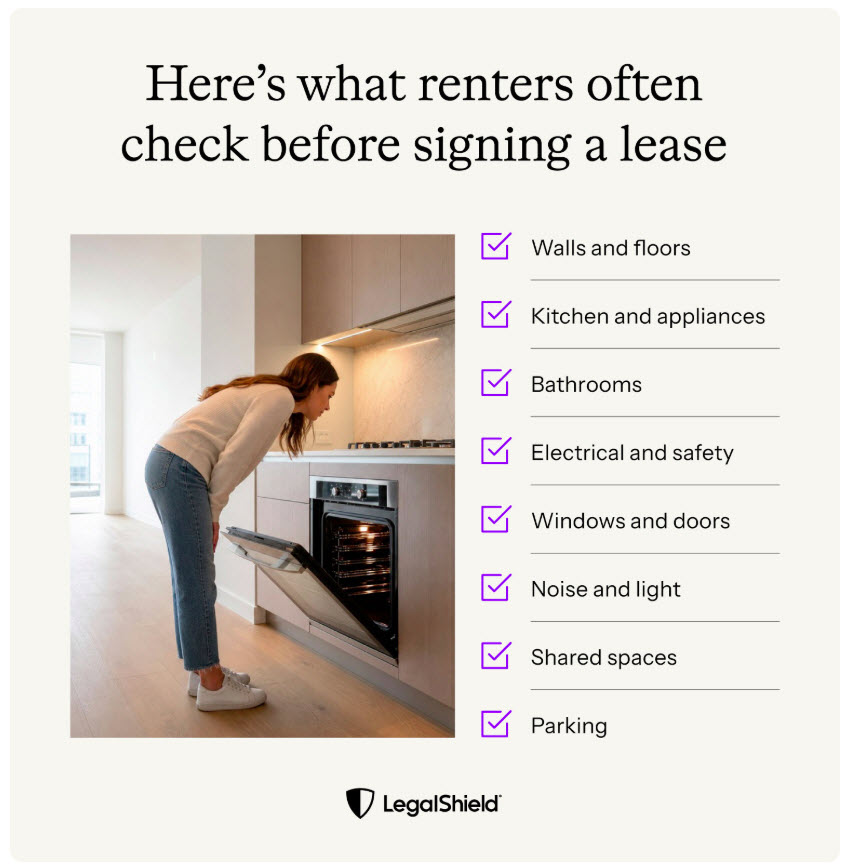
6. Can I do a full walkthrough before signing?
Pre-lease property walkthroughs let you assess the property's condition before signing. Landlords eager to rent should be ready to show the property so you can find out whether it's a good fit. If they’re resistant to allowing you to tour the property, they may be trying to hide something.
7. Is there an existing damage checklist or move-in inspection form?
Move-in inspection forms are room-by-room checklists used during move-in and move-out to document potential damage. These should be detailed and cover everything from the walls to the plumbing system. If your landlord doesn’t have one, you could be blamed for pre-existing damages to the location. Ask for one to be drawn up and have a LegalShield Provider Lawyer review it before you say it looks good.
8. What damages are tenants responsible for?
Finding out what damages you’re responsible for helps clarify the differences between damages and actual wear and tear. Without clarification, you might end up losing your security deposit. Some states restrict a landlord’s ability to withhold a security deposit for wear-and-tear damage, limiting withheld deposits to outright neglect and abuse of the property.
9. What security features are available (key fobs, cameras, controlled access)?
Helpful safety features include controlled access, adequate outdoor lighting, key fobs, secure package delivery, and an intercom system for the main building. These features can help ensure your home and vehicle are well-protected against burglary.
Questions about the security deposit and lease terms
Many locations require that the tenant pay a security deposit before moving into the property.
10. What are the lease terms?
The lease agreement spells out how long you can live at the property and whether there are any restrictions. While term lengths are commonly for one year, many landlords allow shorter or longer terms. Some may even offer discounts for longer-term leases.
11. How much is the security deposit?
Some local laws restrict the security deposit amount, limiting it to one or two months' rent. To find out whether your state, county, or city has restrictions on security deposits, consider contacting a lawyer familiar with local laws.
12. What are the conditions for getting the security deposit back?
Some lease agreements require you to meet certain conditions to get your security deposit back. These could include shampooing the carpet, fixing small nail holes, or replacing light bulbs. Knowing this ahead of time will help you plan for a smoother move-out experience.
13. How long after move-out is the deposit returned?
Landlords should have a good idea of how long it takes to get the deposit back. Provided rent payments were received and the property is in good condition, some states require that the deposit be returned within a certain time period, such as one month.
14. What notice is required before moving out?
The notice you need to provide to your landlord varies depending on your lease terms. For the renter, these notices are typically 30 to 60 days before the planned move-out date. If this is in the middle of a lease term, you might also have to pay extra fees or all of the total rent due to break your lease.
15. Is month-to-month renting available after the lease ends?
Month-to-month rental agreements have flexible terms that renew every 30 days. While you may have the option to renew, some landlords automatically switch to a month-to-month agreement after the lease term is up, while others terminate the lease and ask you to move out. Month-to-month terms may be preferred if you plan to move out before next year.
16. What happens if I need to break the lease early?
Breaking the lease often comes with late fees and penalties. It’s important to understand exactly what will happen just in case you need to break the lease, and that’s where a lawyer can be helpful.
A LegalShield Personal Plan connects you with a network of provider lawyers that can help you understand complex lease contracts. They can review the document on your behalf and let you know what will happen during a lease termination, including your rights as a tenant under local laws. If you have a LegalShield Preferred or Premium Personal Plan, a provider law firm can handle the negotiation with your landlord on your behalf.
17. Is renters’ insurance required?
Renters' insurance is required by some landlords to cover the property in case of damage. These policies typically require minimum liability limits, which can vary based on the lease terms. Ask your landlord how much coverage is needed before purchasing any policy. Even if it isn’t required, consider renters insurance to protect your personal belongings and financial assets.
Questions about maintenance and repairs
Beyond the damage to the apartment, it’s also important to know who is responsible for maintenance and repairs. Ask your potential landlord these questions:
18. Who is responsible for repairs, and how do I request them?
The landlord should be responsible for most repairs, especially larger items like the roof, furnace, water heater, air conditioner, and other major appliances. However, you may be responsible for smaller repairs, such as unclogging your own toilet and changing the light bulbs. Be sure to ask about outdoor needs as well, like fallen trees or a damaged fence.
19. Is there emergency maintenance after hours?
Emergency maintenance is handy if you run into an issue outside the front office's hours. Ask if there’s a maintenance supervisor on staff who lives on the property or nearby for quick responses. If not, you might have to wait several hours for someone to arrive to perform an emergency repair.
Questions about pets, guests, subletting, and changes to the unit
If you’re wondering about pets, guests, subletting, or any changes to the unit, make sure you ask these leasing questions:
20. What is the pet policy, and are there pet fees or deposits?
Some rental communities ban pets completely, while others require prospective tenants to pay a pet fee. Others may have restrictions on certain kinds of pets, such as a particular breed of dog. Rules differ for support animals (covered by the Americans with Disabilities Act) and emotional support animals, so if you have questions about what the landlord can and can’t require for each, it’s a good idea to discuss with a lawyer.
21. Are guests or long-term visitors allowed?
Some rental companies have restrictions on how long a guest can stay, so make sure you check in if you plan on having any overnight or long-term guests. Extended stays can result in your guest being considered a tenant or even cause you to be violating the terms of your lease.
22. Can I sublet or add a roommate?
Whether adding a roommate or subletting your apartment, you will need your landlord’s approval to get it done. They likely will have to go through their own tenant screening, with all parties signing a new formal lease amendment. There may even be changes to the total rent, the security deposit, or the online payment setup as you split the rent with an additional roommate.
23. Can I make changes to the unit?
Some lease agreements restrict the ways you can make changes to an apartment. For instance, you may not be allowed to paint or change light fixtures. Some leases even forbid the use of nails to hang pictures. It’s a good idea to ask about this before signing a lease, especially if decorating a space is important to you.
Red flags to look out for before signing a lease
When landlords start to answer your questions, look for these red flags:
- Cash-only payments: If the landlord asks you to pay in cash and accepts no other payment methods, that’s a huge red flag and could lead to issues when proving you paid your rent on time.
- Verbal agreements: While they may be enforceable for short-term leases, it can be more difficult to prove the terms if you have a dispute.
- Deposit before signing: Asking for a deposit or holding fee before you have a fully signed lease or any agreement is a red flag. Small application fees are an exception to this rule.
- Won’t provide the lease for review: If the landlord won’t provide a copy of the lease for you to review before signing, they may be trying to hide something.
- Refusal to answer questions: While landlords may not have answers for all of these questions, an unwillingness to answer any questions is a concern.
- Blank parts of the contract: Blank sections that they insist on filling in later are a red flag. They could fill this section in with anything that benefits them later.
Sign up for a LegalShield Personal Plan for document review
This isn’t an exhaustive list of all the questions you could ask, as you might come up with more along the way. The more you understand early, the better prepared you’ll be when things go sideways. That’s why it’s good to have a lawyer in your corner.
A LegalShield Preferred or Premium Plan includes assistance with leases to help you navigate some of the trickier sections of an agreement. If something seems off, a provider lawyer can help you communicate with the landlord.
Contact an Independent Associate to sign up for a LegalShield Plan to get your questions answered by our network of provider law firms today.
LegalShield is a trademark of Pre-Paid Legal Services, Inc. (“LegalShield”). LegalShield provides this blog as a public service and for general information only. The information made available in this blog is meant to provide general information and is not intended to provide legal advice, render an opinion, or provide a recommendation as to a specific matter. The blog post is not a substitute for competent legal counsel from a licensed professional lawyer in the state or province where your legal issues exist, and you should seek legal counsel for your specific legal matter. All information by authors is accepted in good faith. However, LegalShield makes no representation or warranty of any kind, express or implied, regarding the accuracy, adequacy, validity, reliability, availability, or completeness of such information. The materials contained herein are not regularly updated and may not reflect the most current legal information. No person should either act or refrain from acting on the basis of anything contained on this website. Nothing on this blog is meant to, or does, create an attorney-client relationship with any reader or user. An attorney-client relationship may be formed only after the execution of an engagement letter with an attorney and after that attorney has confirmed that no conflicts of interest exist. Nothing on this website, or information contained or transmitted by this website, is intended to be an advertisement or solicitation. Information contained in the blog may be provided by authors who could be a third-party paid contributor. LegalShield provides access to legal services offered by a network of provider law firms to LegalShield members through membership-based participation. LegalShield is not a law firm, and its officers, employees or sales associates do not directly or indirectly provide legal services, representation, or advice.