
There are many types of bankruptcies, each applying to a different situation. Two of the most common types are Chapter 7 bankruptcy and Chapter 13 bankruptcy.
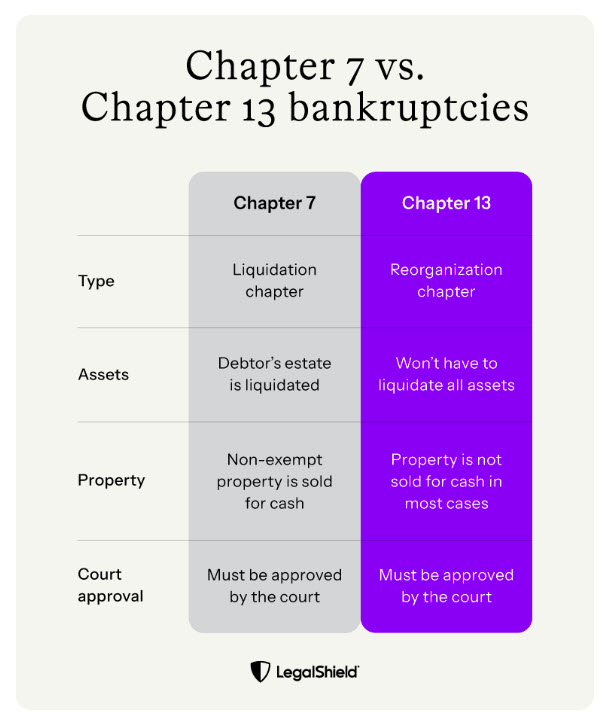
With a Chapter 7 bankruptcy, you liquidate (sell) most of your assets to pay your creditors. You can usually keep some exempt assets. This sometimes includes a home and vehicles, depending on your state’s exemption laws.
With a Chapter 13 bankruptcy, you consolidate your debt and commit to a repayment plan. You usually have three to five years to pay off creditors. Chapter 13 is also called the “wage earner’s” plan because it can be a good option for people with a steady income.
These types of bankruptcies are not the only options. Also, whatever type of bankruptcy you choose, there will be specific steps to follow. It can help to speak with a lawyer first.
Completing mandatory credit counseling
Before filing for bankruptcy, most people need to complete a credit counseling course. This is partly to determine whether there are other ways to pay off debt. If you don’t take a class, the court could dismiss your bankruptcy case.
Credit counseling must come from an agency approved by your state and judicial district. You can find approved courses near you through this U.S. Department of Justice website.
There are often course fees, and you usually need to take classes within a set number of days.
.jpg)
Gathering financial documents
Filing for bankruptcy usually requires gathering a ton of financial documents so you can prove income, debts, and more to the bankruptcy court. For some docs, you may need to go back several years.
According to U.S. bankruptcy law 11 U.S.C § 521, you’ll need this information:
- Personal ID: Driver’s license or state government ID, and your Social Security card
- Income records: Pay stubs going back 60 days before filing, proof of unemployment benefits, spousal support, or income from other sources, and investment and retirement account statements going back two months
- Tax returns: Tax returns going back two years for Chapter 7 or four years for Chapter 13 (unless exempt)
- Bank statements: Bank statements going back two months
- Debt statements: A list of your creditors, account numbers, and amounts you owe
- Asset documents: Mortgage and loan statements, home and car valuations, and a list of valuables and antiques you own
- Credit counseling (proof of completion): Certificate of completion for your credit counseling course
If you’re overwhelmed by this list, we get it. That’s a lot of paperwork. And there may be even more things you need, depending on your situation, such as a divorce decree or a child support order.
A LegalShield Membership includes consultations on an unlimited number of personal legal matters. With an affordable plan, you can talk to a provider law firm about what information to round up before you file.
Filling out the required forms
In addition to gathering documents, there are pages and pages of bankruptcy forms to fill out. Some of them you may need when filing, others you may need to fill out during and after your bankruptcy case.
For example:
- Form B106 Summary asks for a summary of your assets and liabilities
- Form B107 is a statement of your financial affairs and summarizes your financial transactions
- Form B106C is for property you want to exempt
You can find these forms (and more) and download them through the United States Courts website. Some forms may vary by state and jurisdiction.
Filing a bankruptcy petition and attending the 341 Meeting of Creditors
Once you’ve completed credit counseling and gotten everything you need together, you can file a bankruptcy petition with the court through your lawyer. There are filing fees, but they don’t have to be a barrier. You can pay in installments. In some cases, you can even request that the fee be waived.
After you file, there is a Section 341 Meeting of Creditors. This isn’t a hearing, and there’s no judge present. Your court-appointed bankruptcy trustee runs it. They’ll ask you questions under oath about the paperwork you’ve filed. They might also ask about your debts, income, and expenses. You and your lawyer may be able to attend this meeting by video conference.
Sometimes, creditors also attend the 341 meeting to ask you questions, but this is rare. As long as the trustee doesn’t object to anything, you can usually move forward with discharging your debts.
Completing debtors' education and any additional requirements
You probably want to avoid the mistakes that led to your bankruptcy filing again. To help prevent this, you are usually required to take a debtor's education course after filing, before you can fully discharge your debt. This is different from the credit counseling course you take before filing. You usually need to take it within 60 days of your 341 Meeting.
There might be other things you need to do, too, such as submitting any missing financial records or proof of debt payments. You may also need to sign Reaffirmation Agreements for any debts you want to keep. A Reaffirmation Agreement is a voluntary agreement made during a Chapter 7 bankruptcy in which you agree that a specific debt will not be discharged in your bankruptcy. You remain legally responsible for paying that debt even after your bankruptcy case is completed. For example, you might want to reaffirm that you’ll pay your vehicle loan so you can keep your one car.
Keep in mind that if you sign an agreement and don’t pay, creditors may be able to take action against you. It could help to talk to a lawyer first.
How long does it take for bankruptcies to process?
The entire bankruptcy process can take several months. Remember that it typically starts with taking a credit counseling course within 180 days before filing.
After filing for Chapter 7, you generally have a limit of 100 days to get everything done. When you finish the debtor education component, there may be a waiting period.
The timeline is different for Chapter 13. You’ll usually still need to do credit counseling within 180 days before filing. Typically, within 50 days after filing, you’ll meet with your creditors. After the meeting, you can often get a confirmation hearing on your repayment plan and confirmation order within days.
Chapter 13 processing is often faster than Chapter 7 because you are not liquidating assets and discharging debts all at once. Instead, you make a long-term payment plan. Creditors may not object because they know they’ll get what’s owed.
What if the court rejects my bankruptcy application?
Many bankruptcy application filings are successful, but sometimes, the court will reject a petition.
Common reasons for dismissal may include administrative issues such as missing or incorrect paperwork or unpaid fees. These are normally pretty easy to correct, but you might need to re-pay filing fees, and the last thing you want to do is waste money.
It can be much more serious if a judge dismisses your case because they don’t believe you meet the minimum income requirements to dispose of your debts. It can also be serious if your dismissal involves allegations of fraud or if the court thinks you have hidden assets or violated orders.
When denials happen, you have a few options. You could have a lawyer file a motion to reconsider and send documents to correct the problem. You could fix the error and have a lawyer file a new petition (and pay fees). Or you could convert to a Chapter 13 bankruptcy if possible (and pay fees).
Get legal guidance from a LegalShield Provider Law Firm before filing
When you find yourself struggling with debts you can’t pay, filing for bankruptcy can provide relief. But it’s a major decision, and the process is usually complex. It involves checking certain boxes and gathering necessary paperwork. A LegalShield Plan gives you access to a provider law firm that can answer your questions before it ends up in court.
A LegalShield Subscription also gives you access to consumer credit services, tax audit assistance, and more.
Reach out to an independent associate for full plan details or to enroll.
Sources:
- United States Courts. (2026). Bankruptcy Forms. United States Courts bankruptcy forms
- U.S. Government Publishing Office. (2011). 11 U.S.C. chapter 5, subchapter II. GovInfo. 11 U.S.C. chapter 5, subchapter II
- U.S. Department of Justice. (2026). List of Credit Counseling Agencies Approved Pursuant to 11 U.S.C. § 111. Approved credit counseling agencies list
LegalShield is a trademark of Pre-Paid Legal Services, Inc. (“LegalShield”). LegalShield provides this blog as a public service and for general information only. The information made available in this blog is meant to provide general information and is not intended to provide legal advice, render an opinion, or provide a recommendation as to a specific matter. The blog post is not a substitute for competent legal counsel from a licensed professional lawyer in the state or province where your legal issues exist, and you should seek legal counsel for your specific legal matter. All information by authors is accepted in good faith. However, LegalShield makes no representation or warranty of any kind, express or implied, regarding the accuracy, adequacy, validity, reliability, availability, or completeness of such information. The materials contained herein are not regularly updated and may not reflect the most current legal information. No person should either act or refrain from acting on the basis of anything contained on this website. Nothing on this blog is meant to, or does, create an attorney-client relationship with any reader or user. An attorney-client relationship may be formed only after the execution of an engagement letter with an attorney and after that attorney has confirmed that no conflicts of interest exist. Nothing on this website, or information contained or transmitted by this website, is intended to be an advertisement or solicitation. Information contained in the blog may be provided by authors who could be a third-party paid contributor. LegalShield provides access to legal services offered by a network of provider law firms to LegalShield members through membership-based participation. LegalShield is not a law firm, and its officers, employees or sales associates do not directly or indirectly provide legal services, representation, or advice.