
On the surface, writing a Will yourself might seem like a great way to stay on budget, but there are hidden costs that go into this process. You can waste time with DIY Wills if they require rewrites later. There could also be future legal expenses if your loved ones need an attorney to fix a mistake.
Let’s take a look at the factors that go into your DIY Will cost and explore your other options.
The following factors can impact the amount of time and money you spend using DIY options:
- How complex the estate is: Small estates might need a simple Will, but creating one can be costly if there are major assets.
- Family dynamics: A Will costs more when you are dealing with minor children or blended families.
- State-specific legal requirements: Some options discussed below aren't available in every state.
- Hidden probate and legal fees: A DIY Will kit can rack up hidden legal costs if a mistake leads to a legal challenge.
- Tax implications: Larger estates usually have more tax obligations than smaller estates.
- Your personal time investment: Making a Will takes time, even if you start with a template.
- Maintenance and update costs: You should review your Will after major life events to make sure it still fits your needs. Most people don’t think of these update costs when they create their Will in the first place.
Having a Will is important, but you’ll benefit from thinking about more than what a Will costs.

Top 4 methods of creating your own Will
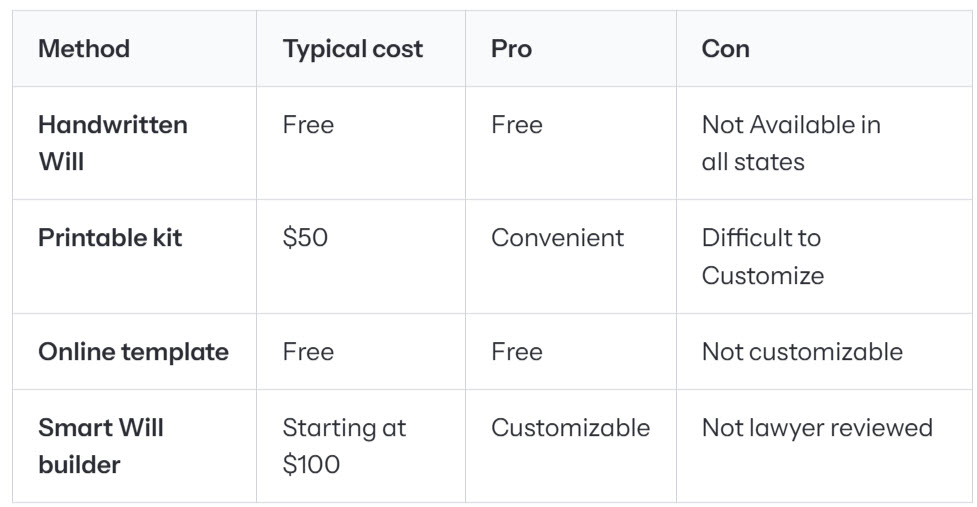
Regardless of the type of Will you intend to create, there are multiple DIY options available to you. Some of the most popular options include the following:
Method 1: Make a handwritten Will
Typical cost: Writing your own Will doesn’t cost any money, but the time investment can be significant.
It doesn’t get any more DIY than writing your own Will out by hand. This option is ideal if you have few assets and want to keep the cost of a simple Will down. Before you choose this option, be sure to double-check that your state recognizes handwritten Wills.
Pros:
- Free
- Convenient
- Witnesses might not be needed
Cons:
- Not an option in every state
- Increased risk of errors
- Potential for court challenges
Method 2: Use a printable DIY Will kit
Typical cost: You can find these Do-It-Yourself Will kits online for anywhere from $15 to $50.
Pros:
- Convenient
- Inexpensive
- Easy to use for small estates
Cons:
- Difficult to customize
- Lacks professional oversight
- Uses basic templates
There is a level of convenience that comes with this approach, as most people can order a kit online and receive it the next day. This option is best for someone with a simple estate who is budget-conscious but also wants to avoid the hassle of handwriting a Will.
These kits can be risky. Using a template means relying on documents that could be out of date. If you want to make sure the Will is problem-free, you’ll have to hire a lawyer to review it.
Method 3: Download a free online Will template
Typical cost: The Will templates some state and local governments offer can be downloaded for free.
Pros:
- Free
- Simple to fill in
- Comes from an official source
Cons:
- Not customizable
- Not reviewed by a lawyer
- It could be out of date
These templates are typically offered at no cost and can avoid some of the pitfalls of a handwritten Will as long as they come in a fillable PDF format. They can also be an excellent tool for taking notes when outlining what you want to include in your Will.
However, these forms might be generalized, only apply to a state you don’t live in, or be outdated due to changes in the law. Like any other DIY option, you run the risk of errors when you don’t have a lawyer review your Will.
Method 4: Try a one-time smart Will builder
Typical cost: The cost to make a Will with these services varies but can range from $30 to $100.
Pros:
- Flexible
- Often comes with step-by-step guidance
- Quick
Cons:
- No lawyer review
- More expensive option
- Limited support
The major benefit of smart Will builders is that they often come with customizable options and a degree of hands-on support. It’s important to remember that while you might get some guidance, your Will is not being reviewed by a lawyer. You are still responsible for putting together a Will that can hold up in court.
Cost savings of an affordable legal services plan
Typical cost: Cost-saving subscription plans like LegalShield start at $30 per month.
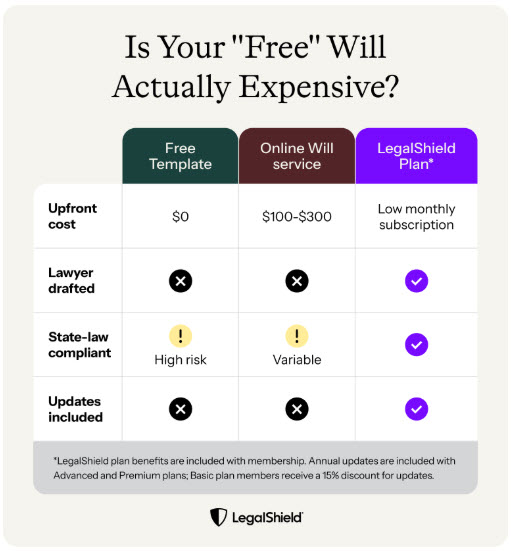
Legal subscription plans like LegalShield have the advantage of providing you with a document that a lawyer has drafted or reviewed.
LegalShield personal plans include other estate planning services. Your lawyer can help with other important documents or provide help with revising your Will in the future. What’s more, the only cost of Will preparation is your membership fee.
.jpg)
Hidden costs of making your own Will
Most people opt to make their own Will to save money, but they don’t always take into account these hidden costs:
- Time spent researching and second-guessing: Even when a Will doesn’t cost you any money, it can take up a lot of your time. Any research related to your Will is up to you, and you could spend countless hours second-guessing your choices.
- Mistakes that make your Will invalid: If your Will won’t survive a challenge in court, your loved ones could be saddled with the cost of litigation.
- Attorney and court fees your loved ones might face later: Even a single mistake in your Will could lead to additional probate proceedings or the need for future legal support. These mistakes can also cost time, as clearing up errors in probate court can take months.
When to get legal help with your Will
More often than not, the benefits of seeking out help with your Will outweigh any downsides. Legal subscription services like LegalShield give you an option that balances affordability with peace of mind.
Still not sure if you need help? You could use a hand if you want any of the following:
- Lawyer-drafted or reviewed Wills
- Ongoing support
- Less expensive than hiring a lawyer
- Less risky than creating a Will on your own
In addition to having a lawyer draft your Will on their own, they can also review a Will you have created. Along the way, they can highlight errors and help you understand what to include in a Will.
Become a LegalShield Member to stress less about DIY Will costs
Having a Will is an important milestone in your life, but that doesn’t mean you shouldn’t consider how expensive it might be. There are ways to save money, but they usually don’t involve a lawyer.
Legal subscription services like LegalShield are the best of both worlds. With your subscription, you can continue to receive ongoing support after your Will is drafted, like having your questions answered about estate accounts or living Wills.
Our legal plans are affordable, and you can choose from multiple options. Reach out to an independent associate to learn how LegalShield can help with your Will.
LegalShield is a trademark of Pre-Paid Legal Services, Inc. (“LegalShield”). LegalShield provides this blog as a public service and for general information only. The information made available in this blog is meant to provide general information and is not intended to provide legal advice, render an opinion, or provide a recommendation as to a specific matter. The blog post is not a substitute for competent legal counsel from a licensed professional lawyer in the state or province where your legal issues exist, and you should seek legal counsel for your specific legal matter. All information by authors is accepted in good faith. However, LegalShield makes no representation or warranty of any kind, express or implied, regarding the accuracy, adequacy, validity, reliability, availability, or completeness of such information. The materials contained herein are not regularly updated and may not reflect the most current legal information. No person should either act or refrain from acting on the basis of anything contained on this website. Nothing on this blog is meant to, or does, create an attorney-client relationship with any reader or user. An attorney-client relationship may be formed only after the execution of an engagement letter with an attorney and after that attorney has confirmed that no conflicts of interest exist. Nothing on this website, or information contained or transmitted by this website, is intended to be an advertisement or solicitation. Information contained in the blog may be provided by authors who could be a third-party paid contributor. LegalShield provides access to legal services offered by a network of provider law firms to LegalShield members through membership-based participation. LegalShield is not a law firm, and its officers, employees or sales associates do not directly or indirectly provide legal services, representation, or advice.