
You’ve probably heard the word “probate” plenty of times in your life, but do you actually know what it is? Probate is the court process for handling a person’s estate after they pass away. It’s a process that can take time, add costs, and create extra work for loved ones during an already difficult time. That’s why people often want to know how to avoid probate.
The probate process can involve court filings, notices, deadlines, fees, and probate documents. For some estates, this is a relatively smooth process. Others take longer because of disputes, unclear documents, or state-specific rules.
The right approach can depend on your state probate laws, assets, and family situation. LegalShield® Provider Law Firms can help you navigate those factors with consultation, but in the meantime, here’s a broad look at ways estates can avoid probate.
How to keep your estate out of probate: Common tools and strategies
Nothing guarantees that your assets stay out of probate. But there are several proven estate planning tools that can make it much more likely. Keep in mind that the right approach depends on the property, how it’s owned, who you want to receive it, and your state’s probate laws.
Set up a Living Trust
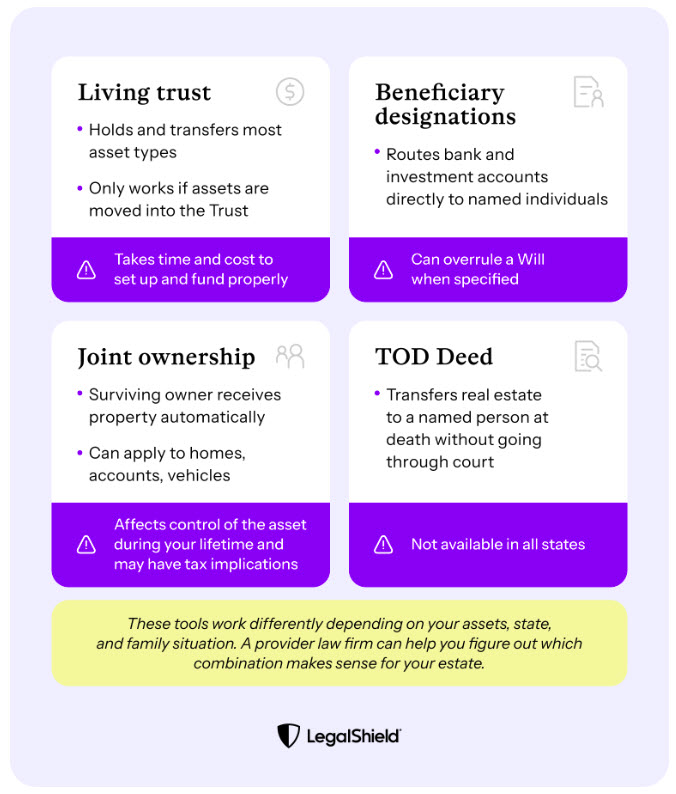
A Living Trust is a legal document that can hold and manage assets and help transfer them without probate after your death.
This is one of the more direct probate-avoidance tools. However, there’s a big caution: The Trust usually only works as intended if you transfer the assets into the Trust.
The cost and process vary widely, depending on your estate, your state, and the type of Trust. This guide to the cost of a Living Trust explains some of the factors that affect the price.
Name beneficiaries on financial accounts
Certain financial accounts can pass directly to named beneficiaries without going through probate. Bank accounts — like checking, savings, and certificates of deposit (CDs) — can often use a Payable-on-Death (POD) designation. Investment, brokerage, and life insurance accounts typically use a Transfer-on-Death (TOD) or a beneficiary designation. The account type determines which designation applies, and not every institution offers both.
It’s worth reviewing your beneficiary designations after major life events: marriage, divorce, the birth of a child, or the death of a loved one. Outdated designations can create confusion or even send assets somewhere different from where you intended.
Consider joint ownership
In some cases, two people can own certain property in a way that lets the surviving owner get it automatically when the other person dies. This concept, called joint tenancy with right of survivorship, may apply to a home, bank account, vehicle, or other jointly owned property.
This approach may help keep that property out of probate, but it can also affect who can use, sell, borrow against, or manage the property while you’re alive.
Adding a joint owner can also have tax consequences — including potential gift tax implications and effects on the property's cost basis when it's eventually sold. Before making any changes to how a property is titled, it's worth speaking with both a lawyer and a tax professional.
Look into Transfer-on-Death Deeds
A TOD can let real estate pass directly to a named beneficiary after the owner dies. These deeds are not available in all states, but when they are available, they can help keep homes and other real estate out of probate.
Because the rules for TOD Deeds vary, it’s helpful to learn more about how to transfer property without probate and ask a lawyer whether this option is available where you live.
Know your state's small estate options
Some states give smaller estates a bit of a break, such as fewer court steps or a shorter overall process. That depends on the value of the estate and the rules in your state.
These small estate rules can be quite specific. For example, in most states, simplified small estate options are generally not available if there is a valid Will. So if you want to do this right, it's a good idea to chat with a legal professional. They can help explain whether a simplified process applies to your estate and what your local laws say.
.jpg)
Does a Will avoid probate?
Unlike a Living Trust, a Will doesn't avoid probate — it goes through it. A Will tells the court who should receive your assets and who should handle your estate, but the court still oversees the process. Having a Will can make probate smoother and clearer, but it doesn't replace the court's involvement.
Which assets have to go through probate?
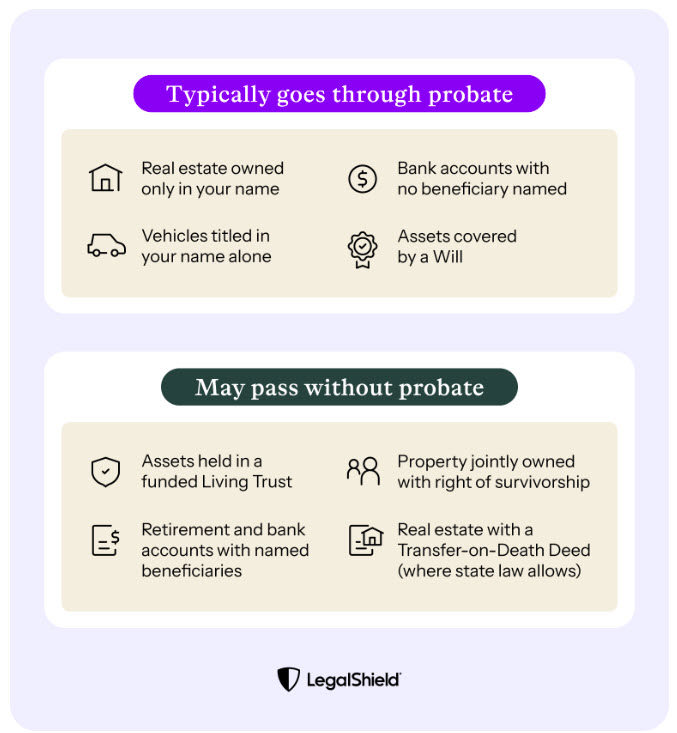
Not all assets have to go through probate. Some common kinds of assets may not be subject to probate:
- Assets held in a properly funded Living Trust
- Bank, retirement and investment accounts with a POD, a beneficiary designation or a co-owner
- Life insurance proceeds when there’s a named beneficiary
- Property that’s jointly owned with right of survivorship
- Real estate covered by a TOD Deed, where allowed by state law
This is again where state-level rules matter. If you’re unsure when probate is required, a lawyer can review the assets and explain which ones may call for court involvement.
How a LegalShield Plan can help with estate planning
Knowing how to avoid probate often starts with understanding which tools fit your estate. But there are lots of tools available: Living Trusts, beneficiary designations, joint ownership, and more. They can all work differently in different contexts.
A LegalShield Membership connects members with a provider law firm that can answer estate planning questions and offer legal guidance. Members may also get help with a Will, Living Will, or Power of Attorney, and can have certain legal documents reviewed.
LegalShield Premium Plan members can get a Living Trust prepared by a provider law firm for a flat fee. Members on other plans may access Living Trust preparation at a reduced rate through the plan's discount benefit. Reach out to an independent associate to explore the estate planning services on each LegalShield Plan to find the one that fits your needs.
LegalShield is a trademark of Pre-Paid Legal Services, Inc. (“LegalShield”). LegalShield provides this blog as a public service and for general information only. The information made available in this blog is meant to provide general information and is not intended to provide legal advice, render an opinion, or provide a recommendation as to a specific matter. The blog post is not a substitute for competent legal counsel from a licensed professional lawyer in the state or province where your legal issues exist, and you should seek legal counsel for your specific legal matter. All information by authors is accepted in good faith. However, LegalShield makes no representation or warranty of any kind, express or implied, regarding the accuracy, adequacy, validity, reliability, availability, or completeness of such information. The materials contained herein are not regularly updated and may not reflect the most current legal information. No person should either act or refrain from acting on the basis of anything contained on this website. Nothing on this blog is meant to, or does, create an attorney-client relationship with any reader or user. An attorney-client relationship may be formed only after the execution of an engagement letter with an attorney and after that attorney has confirmed that no conflicts of interest exist. Nothing on this website, or information contained or transmitted by this website, is intended to be an advertisement or solicitation. Information contained in the blog may be provided by authors who could be a third-party paid contributor. LegalShield provides access to legal services offered by a network of provider law firms to LegalShield members through membership-based participation. LegalShield is not a law firm, and its officers, employees or sales associates do not directly or indirectly provide legal services, representation, or advice.