
Whether you’re at odds with a family member over selling or dealing with a business partner who wants out of a real estate deal, a partition action can help resolve a deadlock.
A partition action can help give you a path forward when you just can’t agree with a property co-owner — even if you’ve reached a stalemate. We’ll walk you through how it works.
What is a partition action?
A partition action is a legal tool you can use if you and a co-owner can’t agree on what to do with a shared property. It typically asks the court to split the property, order a sale, or approve another way to separate your share from the other owner’s share.
You can’t just remove someone from a deed because of a disagreement. But in some cases, you have a right to ask the court to decide whether to divide or sell the property through a partition. That’s true even if you own a smaller share of the property. The process helps you get compensation for your share in a property that you have rights to but don’t want to keep. This way, you don’t have to choose between being tied to a property and giving up your rights to it.
A partition lawsuit sounds intense, particularly when the dispute involves siblings, family land, or a home shared with your ex. But when communication has broken down, this may be the clearest way to settle the matter and let each owner move on.
Common scenarios that lead to partition lawsuits
Multiple real estate owners may not agree on the next steps in these situations:
- Inherited property: You and your siblings inherit a family home. You want to sell the property, one sibling wants to keep it and rent it out, and another wants to move in and live there.
- Relationship breakdowns: You and your partner co-own your home, but aren’t married, and are now separating. You might need a partition action if you disagree about the property.
- Financial disagreements: Repairs, property taxes, insurance, mortgage payments, upkeep. If you’re arguing with a co-owner about these things, a partition action might provide a solution.
These are difficult disputes because everyone with a right to the property must be considered. Especially for families, a court-ordered partition is a significant legal step that you should weigh carefully. Through negotiation or guided mediation, you may be able to come to a different agreement, like a voluntary buyout or a rental agreement.
Legal guidance can help you understand your options.

Three ways a court can split your property
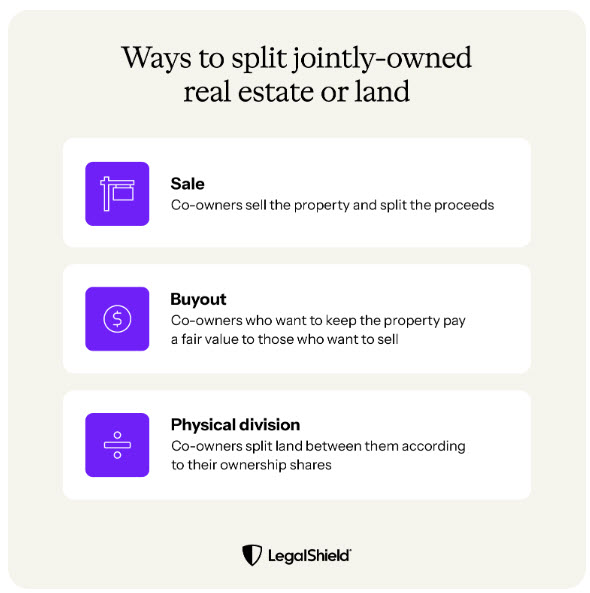
Courts typically choose one of three paths when someone files a partition action: dividing the land, selling the property, or allowing one owner to buy out the other(s).
Partition in kind
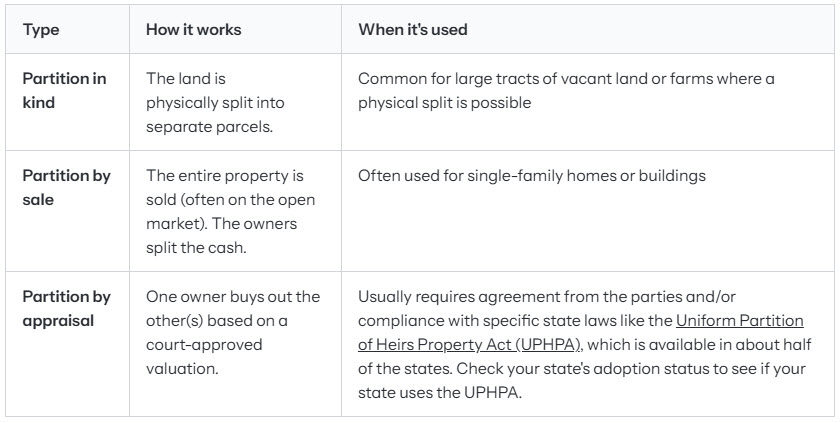
A partition in kind divides the property into separate pieces, and each co-owner gets one. They can do whatever they want with their slice of the pie — sell it, build on it, or rent it.
This approach is more common with big plots of vacant land, rural property, or farmland, where it’s possible and fair to split the land.
For instance, if three sisters inherit 90 acres, a court could divide it into three 30-acre parcels.
Partition by sale
If your disagreement involves a residential home, you’re likely looking at a partition by sale. It’s not practical (or even possible) to split a home up into parts, so you sell the whole thing and divide the proceeds instead.
Courts may call for the owners to list the property on the open market and sell it for a fair price, or sales are conducted via a court-supervised auction or referee sale. The method varies by state. The co-owners then divide the money (according to their ownership percentages and any court-approved adjustments).
Partition by appraisal
I the disputed property has sentimental value to one of the owners, a partition by appraisal may offer a good solution. Instead of selling the property to a stranger or splitting it into pieces, one owner buys out the other owners.
The “appraisal” piece comes in if the court appoints an independent appraiser to figure out the fair market value of the property. Once the value is determined, the buying owner gets a set amount of time to come up with the funds to pay the other owners for their shares. After that, ownership is transferred, often by a Quitclaim Deed or similar document.
Partition by appraisal is often used for inherited family property. Under laws like the Uniform Partition of Heirs Property Act, an appraisal-based buyout can keep family land from getting into the hands of outside buyers.
What the partition legal process might look like
A partition lawsuit can feel overwhelming. The exact rules vary by state, so get legal guidance for your situation, but here are some things the process might involve:
- Filing the complaint and lis pendens: One owner starts by filing a complaint with the court. They might also file what’s called a lis pendens. That’s just a public notice saying the property’s involved in a lawsuit.
- Determining the right to partition: The court now decides whether the filer has an ownership interest in the property and, as a result, the legal right to ask for a partition. If the filer does have that right, then the court will decide how to divide, sell, or otherwise handle the property.
- Appointing a referee or commissioner: Sometimes (but not always), the court will appoint a neutral third party to help manage the dividing or selling of the property. This person may list the property, review offers, or carry out the court order in some other way.
- Final distribution of proceeds: This only applies if the property is sold. If so, the court decides how to split the money. That’ll depend on ownership shares, approved credits, and court costs.
The costs and timeline for a partition case
A great, big caveat before we get into this: The costs and timeline for a partition case will depend on the state you’re in and the details of your specific case.
As for the timeline, partition actions usually take a little over a year to resolve. If the case is straightforward, it could move faster. That’s also true if the co-owners settle early. If the court is backed up or the case is complex, the process could take longer.
Let’s look at costs commonly tied to partition actions:
- Filing fees and court costs: Courts charge varying amounts to file for a partition action. Further partition-related steps, such as hearings, can drive up these costs significantly.
- Appraisal and inspection costs: If the partition involves selling the disputed property, you’ll likely need an inspection. Even if you’re just buying out your co-owner, you’ll likely need an appraisal to get the fair value. If we’re talking commercial property, rural land, or an unusual property of some kind, the appraisal cost is likely to be higher than it is for residential property.
- Referee or commissioner fees: If the court assigns a third party to help manage the sale or division of the property, that might involve paying their hourly rate, a flat fee, or a percentage of the sale price.
- Lawyer fees: Some lawyers charge hourly rates for working on partitions. Others require a retainer. The total cost is going to vary widely based on the value of the property, the complexity of the case, and the state you’re in.
A LegalShield® Personal Plan can put more affordable legal guidance within your reach.
Who pays partition action costs?
The person responsible for paying partition action costs is highly case-dependent. In some states, some or all of these costs will come out of the sale proceeds before the co-owners split the money.
Sometimes, though, the court decides who pays what. And they can base that on owner conduct, ownership percent, and similar factors.
Can you stop a partition action once it starts?
It’s usually not easy to stop a partition action. That’s because co-owners often have a legal right to ask the court to sell or divide the shared property. One possible exception: You have a written agreement where an owner or owners gave up, limited, or delayed their right to partition.
A buyout offer may be more practical if you’re trying to stop a partition action. One co-owner can offer to buy the other’s share at a fair price (by appraisal or agreement).
One other factor that can put the brakes on a partition action is a divorce. Specifically, if the property is tied up in a divorce, the family court rules are likely to control how that property gets divided. A standard partition action may not be the appropriate path in such a case, and state law also may dictate which approach is used.
How to get legal help for your property dispute
Property disputes are often emotional and expensive. That’s especially true when the property is tied to family, a former relationship, or a business that didn’t work out as planned.
A partition action may be able to help in these situations, but speaking with a lawyer before you file or respond to one can help you understand your options and decide on the next step. With a LegalShield Personal Plan, you can get access to a provider law firm that can discuss next steps in your co-owned property dispute, review certain letters or legal documents, and help you better understand what a partition lawsuit could mean for your ownership rights.
Learn more about LegalShield Personal Plans and how to get access to affordable legal guidance on real estate matters by contacting a LegalShield Independent Associate.
Sources
Uniform Law Commission. (2010). Partition of Heirs Property Act. https://www.uniformlaws.org/committees/community-home?CommunityKey=50724584-e808-4255-bc5d-8ea4e588371d
LegalShield is a trademark of Pre-Paid Legal Services, Inc. (“LegalShield”). LegalShield provides this blog as a public service and for general information only. The information made available in this blog is meant to provide general information and is not intended to provide legal advice, render an opinion, or provide a recommendation as to a specific matter. The blog post is not a substitute for competent legal counsel from a licensed professional lawyer in the state or province where your legal issues exist, and you should seek legal counsel for your specific legal matter. All information by authors is accepted in good faith. However, LegalShield makes no representation or warranty of any kind, express or implied, regarding the accuracy, adequacy, validity, reliability, availability, or completeness of such information. The materials contained herein are not regularly updated and may not reflect the most current legal information. No person should either act or refrain from acting on the basis of anything contained on this website. Nothing on this blog is meant to, or does, create an attorney-client relationship with any reader or user. An attorney-client relationship may be formed only after the execution of an engagement letter with an attorney and after that attorney has confirmed that no conflicts of interest exist. Nothing on this website, or information contained or transmitted by this website, is intended to be an advertisement or solicitation. Information contained in the blog may be provided by authors who could be a third-party paid contributor. LegalShield provides access to legal services offered by a network of provider law firms to LegalShield members through membership-based participation. LegalShield is not a law firm, and its officers, employees or sales associates do not directly or indirectly provide legal services, representation, or advice.