
Your daughter just went off to college and became ill. She goes to the doctor, and they want to see certain records from her childhood, such as shot records. She calls you and asks you to call the family’s long-time pediatrician to acquire the records. No problem – right? You call, and the office tells you that since your child is 18, you are no longer allowed access to her records. Your child is an adult and as a parent, you have lost your authority.
What actually changes at 18?
For 18 years, parents hold legal authority over their child's health care, finances, records, and schooling. They sign the consent forms. They talk to the doctors. They see the grades.
At midnight on the 18th birthday, that authority ends. Your child is an adult. A bank will not discuss the account. Under FERPA, the university may not release grades or disciplinary records, even though the tuition bill has your name on it.
Medical information is where most parents get the shock, and the rule is more slippery than they expect. HIPAA does not flatly forbid a hospital from talking to you. It permits a provider to share information with family involved in a patient's care, and when the patient is incapacitated or unable to speak, it lets the provider use professional judgment about what's in that patient's best interest.
There are two important words at play: may, and judgment. Without a signed authorization, you are not entitled to information about your adult child. You are hoping to get it from a strange doctor you don’t know. On a busy night in an ER at a hospital that emphasized what happens if a resident shares too much — you may get zero information. That’s not a bad hospital or doctor, just one who is being conservative with the law and the information about your adult child.
A signed HIPAA authorization takes the judgment call off the table.
None of this means you stop parenting. It means the tools change. Parenting after 18 just takes more paperwork.
What happens if you don't?
This is the question I get after I explain everything above: what's the worst case, really?
It starts with the unknown and could end up in probate court asking a judge for authority you could have had for the cost of a signature.
If your adult child suddenly becomes incapacitated and no power of attorney exists, the legal remedy is guardianship. In Texas where I practice, that means:
- A sworn application filed in a county court with probate jurisdiction.
- A physician's certificate documenting incapacity, based on an examination conducted within the previous 120 days.
- Serving papers on your child. Your son or daughter must be served with the application because by law they are entitled to notice, and they are entitled to a jury trial if they ask for one.
- A court-appointed attorney ad litem whose client is your child — not you. That attorney's job is to advocate for what your child wants, or what is in the child’s best interest if the child is unable to communicate, including contesting the guardianship.
- A hearing, at which you carry the burden of proving by clear and convincing evidence, some level of incapacity, that there would be a benefit to guardianship, and that a guardianship would work, and proving that no less restrictive alternative exists.
- Ongoing obligation. If the court grants it, you take an oath, post a bond, receive Letters of Guardianship, and then report to that court on a recurring basis for as long as the guardianship lasts.
What does guardianship cost in both time and money?
- Approximately $3K to $5K all in – including about $1K in court costs and the remainder in attorney’s fees.
- About 2 months if uncontested and no complicating factors. Otherwise, it could take a year or more if contested.
- A temporary guardianship just adds to the process and cost, because the regular guardianship will still follow. A temporary guardianship does not require a physician’s certificate, but it does require proof of imminent harm to the person or estate of the ward.
Compare that to the alternative: your child signs three documents at the kitchen table, and it's done.
The contrast is stark. The power of attorney is a private document your child gives you voluntarily. Guardianship is a lawsuit in which your child is the opposing party (even if they want it), with their own lawyer, and a judge decides whether to strip rights the law just finished granting them. Families who skip the first one don't avoid the process. They just meet it later, in public, on the worst week of their lives.
Documents I recommend to all families
Just as parents should put the proper paperwork in place to name a guardian when their kids are young, they also need to think about the proactive legal steps to look out for them after they turn 18.
LegalShield's 2026 parent survey found that among parents with a child 18 or older, 36% have no power of attorney in place for that child.
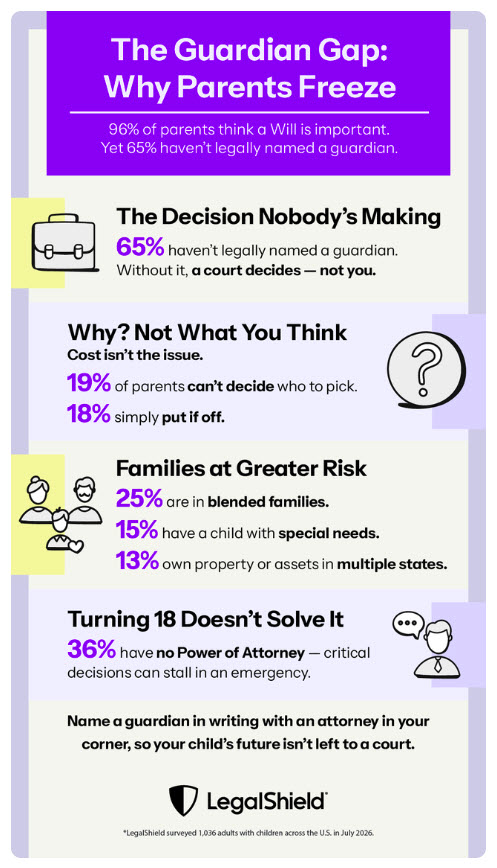
Names vary by state. In Texas we use Medical Power of Attorney and Statutory Durable Power of Attorney. Other states might call it a Health Care Proxy or Advance Health Care Directive, and Statutory Short Form Power of Attorney or Uniform Statutory Form Power of Attorney. Ask a lawyer licensed where your young adult lives. Here are the three essentials:
- Medical (health care) power of attorney. Lets your young adult name you as the person who can make medical decisions if they can't speak for themselves. This is the emergency document.
- HIPAA authorization. Separate from the above, and just as important. This lets providers talk to you — share test results, discuss treatment, answer questions — while your child is still making their own decisions. It's the one most families skip.
- Durable power of attorney for finances. Lets you handle banking, insurance, a lease, a tax filing, or a tuition account if your child is deployed, studying abroad, hospitalized, or simply inexperienced or overwhelmed.
Two more worth considering:
- FERPA release. So the school can talk to you about academic and disciplinary matters.
- Simple will. For young adults with real assets or a child of their own.
Make it their decision
Here's the part parents get wrong: these documents are not something you do to your young adult. They choose you. They sign them. They can revoke them at any time, for any reason.
Framed that way, the conversation goes better. Your kid decides who they want in the room if they can't speak for themselves. Most 18-year-olds, asked directly, say "Mom" or "Dad" without hesitating.
And it's worth telling them the alternative plainly: signing a power of attorney is how they keep the choice. Guardianship is what happens when a judge makes it for them.
The documents you'll use most
The medical documents are typically for the bad day. The financial ones get used constantly.
Most 18-year-olds have never managed a credit card, a rent payment, a deductible, or a credit report. A durable power of attorney doesn't take that responsibility away from them; it lets you step in when they ask, and step in fast when a missed payment is about to become a collections account or a damaged credit file.
Practically, that looks like helping them dispute a fraudulent charge, sort out a billing error, set up a first savings account, or understand what a promotional APR turns into in month 13. Their consumer rights are now their own to enforce, and most of them have no idea what those rights are.
Do it before move-in day
The worst time to discover you have no legal standing is when you're on the phone with an ER.
Put an afternoon on the calendar near their 18th birthday, hopefully before the dorm, before their first adult job, before the enlistment. LegalShield members can talk to a provider attorney in their state about estate planning documents.
Sign the documents. Scan them. Put a copy in your phone and one in theirs. Then go back to parenting, focusing on your kid, not the paperwork.
About the author: John Saltarelli is a LegalShield provider attorney and Partner at Ross & Matthews, P.C.
To become a LegalShield Member, reach out to an independent associate.
LegalShield is a trademark of Pre-Paid Legal Services, Inc. (“LegalShield”). LegalShield provides this blog as a public service and for general information only. The information made available in this blog is meant to provide general information and is not intended to provide legal advice, render an opinion, or provide a recommendation as to a specific matter. The blog post is not a substitute for competent legal counsel from a licensed professional lawyer in the state or province where your legal issues exist, and you should seek legal counsel for your specific legal matter. All information by authors is accepted in good faith. However, LegalShield makes no representation or warranty of any kind, express or implied, regarding the accuracy, adequacy, validity, reliability, availability, or completeness of such information. The materials contained herein are not regularly updated and may not reflect the most current legal information. No person should either act or refrain from acting on the basis of anything contained on this website. Nothing on this blog is meant to, or does, create an attorney-client relationship with any reader or user. An attorney-client relationship may be formed only after the execution of an engagement letter with an attorney and after that attorney has confirmed that no conflicts of interest exist. Nothing on this website, or information contained or transmitted by this website, is intended to be an advertisement or solicitation. Information contained in the blog may be provided by authors who could be a third-party paid contributor. LegalShield provides access to legal services offered by a network of provider law firms to LegalShield members through membership-based participation. LegalShield is not a law firm, and its officers, employees or sales associates do not directly or indirectly provide legal services, representation, or advice.