
If you own a home or other real estate, you may be thinking about who should get it after you die and how to make that transfer easier for your family. That’s one reason some people look into Beneficiary Deeds.
In states that allow these deeds, they can transfer real estate outside of probate. In other words, Beneficiary Deeds can help your beneficiaries skip some of the time, expense, and confusion that can come with transferring a home.
Like all estate planning tools, Beneficiary Deeds aren’t always the right fit for every situation. This article explains how and when you might want one, as well as some things to watch for. We’ll also compare Beneficiary Deeds with other estate planning tools to help you understand the differences.
For more personalized estate planning guidance, a LegalShield® Personal Plan can connect members with provider law firms. Provider lawyers can help you understand your options, ask questions, and prepare or review specific documents.
What is a Beneficiary Deed?
A Beneficiary Deed is a deed that allows a property owner to name a beneficiary for their real estate. A “beneficiary” is the person or organization named to receive the property. These deeds may also be called Transfer-on-Death Deeds (TODDs). Some states use a Beneficiary Deed while others use a TODD form.
How does a Beneficiary Deed work?
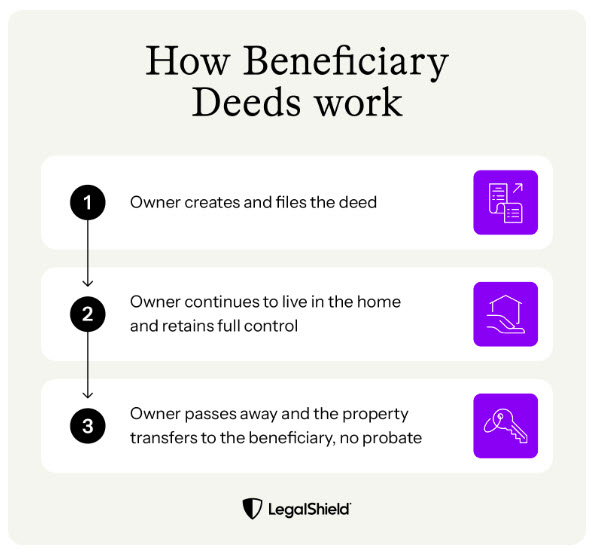
In the many U.S. states that recognize Beneficiary Deeds, the property goes to the named beneficiary automatically after the owner passes away. The beneficiary generally doesn’t have control of the property during the owner’s life.
So, the owner can usually keep living in the home and sell or refinance it if they want to. And they can revoke the deed during their lifetime. But when they pass, if the deed was signed, properly notarized, and recorded, the property in question passes to the beneficiary.
That transfer often happens without probate, too. Still, the beneficiary must take specific steps, such as filing a proof of death or updating property records. The specifics here depend on state and local rules.
Another thing to keep in mind is that joint ownership can affect how a Beneficiary Deed works. For instance, if two people co-own a home, the document might only transfer the signer’s share of the property to someone else. And survivorship rights can sometimes decide what happens before a Beneficiary Deed takes effect.
Advantages of a Beneficiary Deed
A Beneficiary Deed can make a lot of sense in certain real estate planning situations. It’s particularly helpful when the owner wants to retain control of the property while they’re alive but still designate an automatic beneficiary.
With that said, here are some of the benefits of Beneficiary Deeds:
- May cost less than a trust: Beneficiary Deeds may be simpler and less expensive to prepare than trusts in some situations. Importantly, these deeds don’t replace trusts because trusts and estates cover a broader range of estate planning issues.
- Usually revocable: There’s a lot of flexibility here. The property owner can often revoke the deed, change the beneficiary, sell the property, or refinance.
- May promote privacy and simplicity: Probate is not private, and it’s complex. If the Beneficiary Deed helps the property avoid probate, it can mean the beneficiary avoids court filings and additional steps.
Disadvantages of a Beneficiary Deed
Despite their potential for usefulness, Beneficiary Deeds have their limits:
- May not ward off creditors: The property might avoid probate, but that doesn’t make it immune to creditor claims, estate claims, or other valid debts.
- May not be ideal for minors: Practically and legally, leaving property to a minor child can make for problems. Sometimes, a court-appointed adult must manage the property until the child is old enough. If you want to pass real property to a minor using a Beneficiary Deed, you should speak to a lawyer first.
- May be complex with co-owners: The deed might only apply to the deed signer’s share of the property if there are co-owners. Survivorship might also get in the way of the transfer in the first place, depending on the details.
- May not come with a backup plan: What happens if the named beneficiary dies before the property owner? The deed may not work as intended unless it names a contingent beneficiary or state law provides a fallback rule.
- Not available in every state: Some states simply don’t recognize Beneficiary Deeds. And in the states that do, the rules for signing, notarizing, recording, and revoking vary a lot.
Beneficiary deed alternatives or options to consider
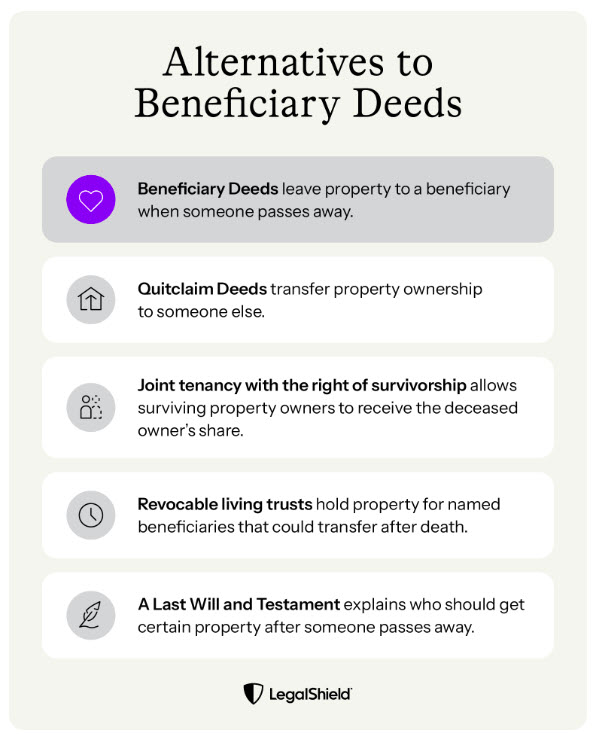
A Beneficiary Deed is just one possible solution to an estate planning problem. You have other options depending on the property, your goals, state law, and other relevant details. Here are some of the alternatives:
.jpg)
Quitclaim deed
A Quitclaim Deed transfers ownership interest in real property to somebody else. This usually happens during the owner’s life, unlike with a Beneficiary Deed. That difference can be useful in some situations, but it can also mean giving up property sooner.
Joint tenancy with right of survivorship
Joint tenancy is a type of shared property ownership. In some states, “joint tenancy with right of survivorship” can allow a surviving property owner to receive the deceased owner’s share without probate. The outcome can be similar to that of a Beneficiary Deed, but it’s more specifically focused on joint tenants.
Revocable living trusts
A revocable living trust is an estate planning document that can hold property for named beneficiaries. During their lifetime, the property owner can often transfer the property into the trust (known as “funding” the trust). The trust explains what happens to the property after the owner dies. This can cover more assets than real estate.
Last Will and Testament
A Last Will and Testament is a document that explains who should get certain property after someone dies. It can also name someone to manage that person’s estate. In a Beneficiary Deed vs. Will comparison, the key difference is that a Will still leads to probate.
Get estate planning guidance with a LegalShield Membership
A Beneficiary Deed can be helpful, but you need to understand how it’ll work in your state and whether you’ll need to coordinate it with a Will or Trust.
A LegalShield Personal Plan can help members answer those kinds of questions by connecting them with a provider law firm for estate planning guidance. Provider lawyers may be able to help you review documents, prepare them, and understand how estate planning tools like deeds can come together.
Get a feel for how a membership can help you with many types of estate planning legal questions. Reach out to your local independent associate for membership details or to enroll.
Sources:
- Maryland General Assembly. States that allow transfer on death deeds. https://mgaleg.maryland.gov/cmte_testimony/2023/jud/1wJMl0zDWp5Hflp893uG1lVthCwpUQK81.pdf
- Arizona State Legislature. Arizona Revised Statutes § 33-405: Beneficiary deeds; recording; definitions. https://www.azleg.gov/ars/33/00405.htm
LegalShield is a trademark of Pre-Paid Legal Services, Inc. (“LegalShield”). LegalShield provides this blog as a public service and for general information only. The information made available in this blog is meant to provide general information and is not intended to provide legal advice, render an opinion, or provide a recommendation as to a specific matter. The blog post is not a substitute for competent legal counsel from a licensed professional lawyer in the state or province where your legal issues exist, and you should seek legal counsel for your specific legal matter. All information by authors is accepted in good faith. However, LegalShield makes no representation or warranty of any kind, express or implied, regarding the accuracy, adequacy, validity, reliability, availability, or completeness of such information. The materials contained herein are not regularly updated and may not reflect the most current legal information. No person should either act or refrain from acting on the basis of anything contained on this website. Nothing on this blog is meant to, or does, create an attorney-client relationship with any reader or user. An attorney-client relationship may be formed only after the execution of an engagement letter with an attorney and after that attorney has confirmed that no conflicts of interest exist. Nothing on this website, or information contained or transmitted by this website, is intended to be an advertisement or solicitation. Information contained in the blog may be provided by authors who could be a third-party paid contributor. LegalShield provides access to legal services offered by a network of provider law firms to LegalShield members through membership-based participation. LegalShield is not a law firm, and its officers, employees or sales associates do not directly or indirectly provide legal services, representation, or advice.